
- working with the multi-metric
The Full Multi-Metric Structure of Tri-space
We have seen how the Minkowski metric of special relativity decomposes into complementary temporal and spatial metrics (on Home page 2) and how connecting these spaces together with a 'Wave Function' provides a new foundation for understanding quantum mechanics (in Fundamentals of Physics).
We have yet to explore the structure and functions of 'Modal Space', which is required to generate the basic frequencies that correspond to the point masses in nature. More than that, together with the space and time metrics, it must cause all of the elementary particles and forces of nature (except gravity - see Laws of the Multi-Metric). The idea of Tri-space does not allow any external rules or quantum numbers or symmetry patterns to be imposed, and there should be fewer fundamental force constants than metrics.
The primary modal space must contain at least one real time dimension, which is aligned (parallel or anti-parallel) to time on the driving metric (Tempospace) when a 'Basic connection' is made. To preserve symmetry, local conservation of this driving sense must occur, providing a mechanism for fermion number conservation. The idea that a definite configuration of modal space must exist, when a fermion pair is created, leads to the universal symmetry of matter and anti-matter.
Going further, we can envisage a positive-only, 3-dimensional space of 2-dimensional oscillation spaces, each of which generates a fundamental frequency. (The 2-dimensions correspond to inertia and restitution in an harmonic oscillator). Comparison with nature tells us that this 3-space must be handed, in some absolute sense (everywhere and forever the same). Driving with reversed time sense projects a negative-only mirror space, so that primary modal space consists of only the all-positve and all-negative octants. Let us call this one 'Lepto-space', because it must generate directly the simple, point particles known as leptons.
However, hadrons are also elementary particles, and these have been found to be composite objects containing / comprising two or three component fermions ('quarks'). These component fermions must represent a new kind of connection in modal space, different from leptons. To make that hang together, I suggest that a fourth metric space exists - a different kind of modal space with no real time dimensions, so that it works as a secondary, oscillation 3-space which cannot be driven directly by tempospace. Let us call this one 'Meso-space', because it can support composite particles with no net fermion number and such particles are known as mesons.
Hadrons are classified in particle physics by several wave function 'parities'. One example involves inversion in real space, but most of them defy description on the Minkowski metric. These parities do correspond to the various inversion symmetries in Tri-space. Only quarks connect the four spaces in sequence, so only hadrons display all of these parities. For example, 'G-parity' involves reversing the tempospace drive sense (and thus the 'charge parity'), together with meso-space inversion.
You can read about the topological quantum numbers that come with the connections of these four metric spaces in The Four Metrics and Thirteen Descriptors . Below is a second version of the Iceberg Diagram, showing the routes of connection for the principal kinds of elementary particles of matter. Gauge bosons connect the metrics in pairs, so that space and time drive into modal space (not shown here). The corresponding fundamental force laws are introduced in The Fundamental Forces.
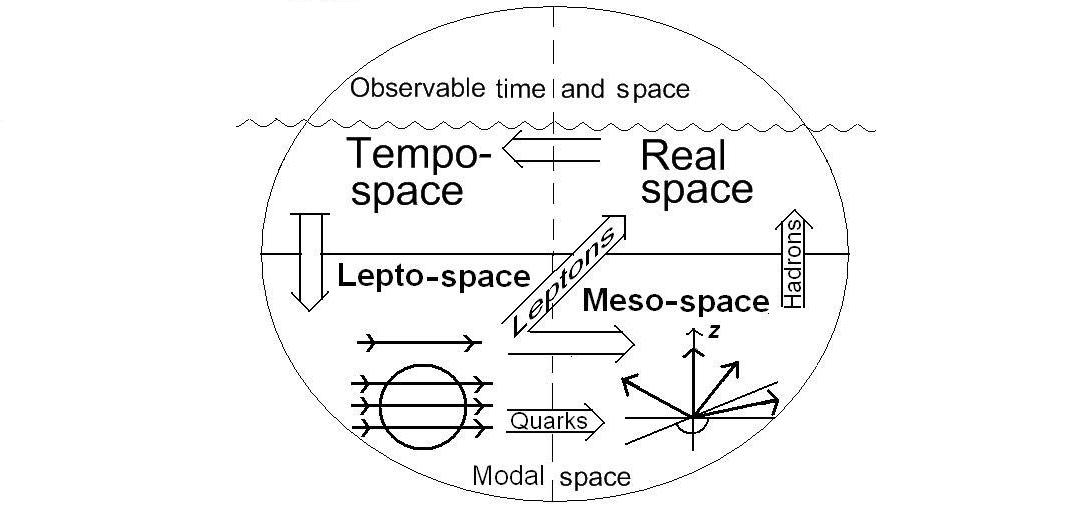
There must also be a third quantisation in nature, associated with the addition of meso-space (see the Zeroth Law in Fundamentals of Physics). The principle of this one is that, when modal space projects a wave function into real space, all quantum numbers in modal space must be fixed, so that they have the same values everywhere. For example, the total charge and isospin (meso-spin) for a system of hadrons must be determined.
Robert Herrod
Örkelljunga, Sweden, December 2024