
- opening new vistas in theoretical physics
Forces of the Multi-Metric Theory
So Tri-space consists of four, distinct metric spaces, which can connect together spontaneously with a wave function, when energy is available. Each pair of spaces, which include at least one space-time metric, can be associated with a characteristic force law. There are five possible force laws, plus one internal energy equation (not involving space-time) - see the diagram. These must correspond to the fundamental forces of nature.
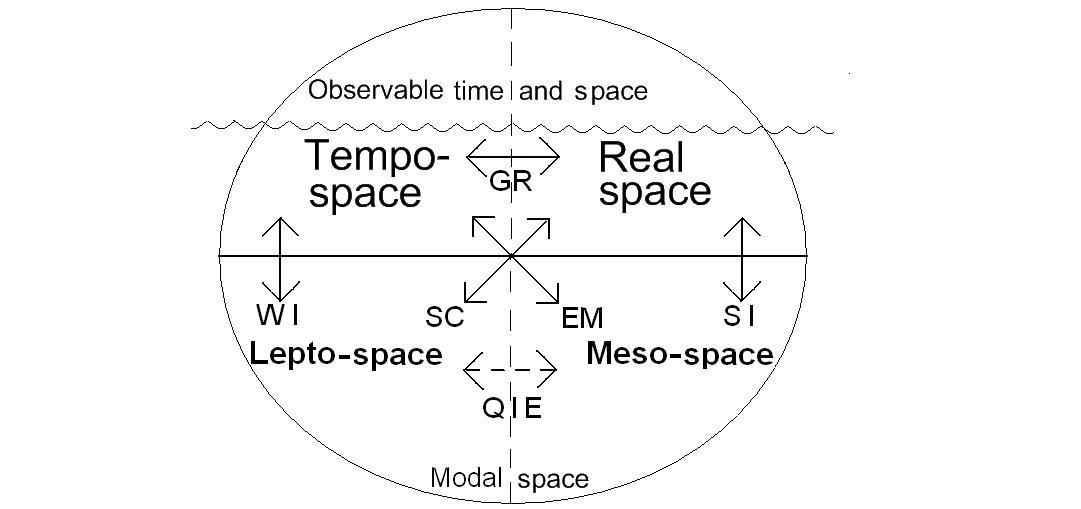
Gravitation (GR) is unique in that it is described using the space and time metrics only (by Einstein's theory of General Relativity), but it fits perfectly into the pattern shown. There is no need for any mediating particle, in this case.
Weak Interactions (WI) involve tempo-space and lepto-space, so they are time dependent (mediated by gauge bosons) and can display spatial handedness in tempospace (originating from lepto-space). These forces can affect all fermions, but they are weak at commonly observed energy levels, because the corresponding gauge bosons have much mass. Where they affect massless fermions, these forces can only involve terms with positive energy.
Strong Confinement (SC) involves lepto-space and real space, so these forces are time independent (not mediated by gauge bosons). They involve positive potential energy, which increases as quarks move apart, with no preferred directions and no upper limits. This prevents any rejoining of metrics involving isolated quarks (see Fundamentals of Physics). The strong confining force may also provide a core repulsion between nucleons, limiting the density of nuclear matter.
Electromagnetic forces (EM) involve tempo-space and meso-space, mediated by a gauge boson with no mass. The photon is coupled to the z-axis projection of total angular momentum in modal space (corresponding to electric charge), which is constructed in meso-space. EM interactions are time dependent, but electrostatic and magnetostatic forces between massive particls are time independent and these forces can involve either positive or negative interaction energy.
Strong Interactions (SI) involve meso-space and real space, so they are time independent and may be spatially complicated. There is no direct evidence for any mediating particles, but some early theories used light mesons to mediate the attractive strong forces between baryons, for example. However, mesons have significant masses, because they contain confined quarks which must also feel this force! In Tri-space theory, it is necessary to find quark connection algebras that facilitate coupling by the strong force. Fitting hadron structure using constituent quark masses suggests that the SI is mainly attractive (negative energy).
Quark Internal Energy (QIE) is a 'shadow force' not observable in space-time. If it has any coupling, it must affect quark point masses, further differentiating them from leptons. It cannot affect massless particles. QIE might provide a link between the confinement and the strong coupling of quarks. We can expect it to contribute to the energy of quark 'mesotwist' in particular, so it would affect the weak decays of heavy quarks (see The Four Metrics and Thirteen Descriptors ).
One feature of this pattern of forces, in regions where there is extreme gravity, is that the time dependent forces could be "frozen out" by time dilation, but that would not affect hadron internal structure. The multi-metric can describe no kinds of fundamental forces in nature, other than those outlined here, or derived from them. The theory suggests that there may be 3 independent force constants in nature.
Robert Herrod
Örkelljunga, Sweden, December 2024