
- opening new vistas in theoretical physics
The Four Metrics and Thirteen Descriptors
So Tri-space consists of four, distinct metric spaces, which can connect together spontaneously with a wave function, when energy is available. Each of the spaces is associated with characteristic quantum numbers, some or all of which are needed to describe the different possible topologies of connection (which correspond to the elementry particles of nature).
In Tempospace, we have intrinsic spin ('Tempospin', equal to 1/2ħ for a fermion) and the temporal drive sense of each point connection (the fermion number). Quarks with opposing tempospins have a net 'Tempo-scalar Charge' (integer times ħ). The absolute number of driven connections is also definite, though it is not conserved by most processes.
In Real space, we have the radial and orbital quantum numbers, which were present in the solutions of Schrödinger's original quantum mechanics. These combine with tempospin to give total angular momentum, which must be conserved, and there is a collective topological quantum number corresponding to the state of bulk matter (solid, liquid or gas).
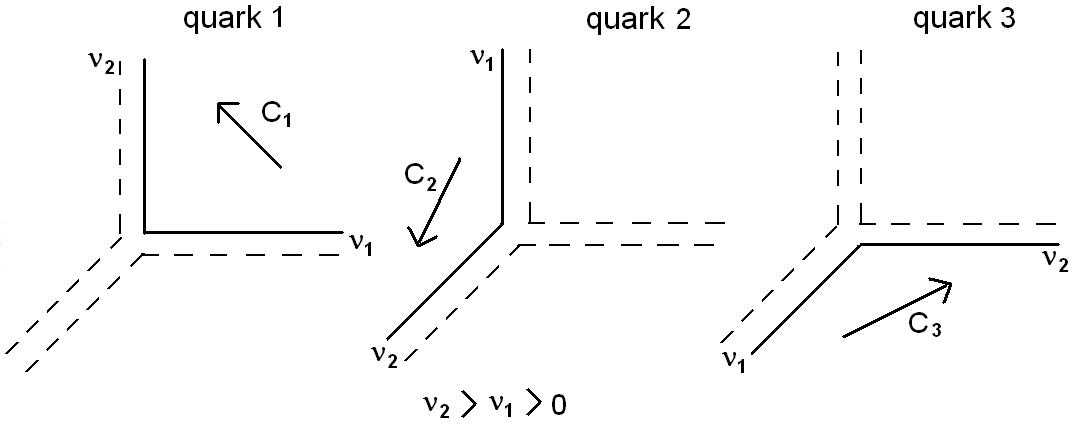
In Lepto-space, each driven configuration of oscillation modes is definite, comprising up to 3 separate 'Leptaves', which represent one of up to 6 possible frequencies (νj - but only a few combinations can describe viable particles). In addition, I suggest a simple 'Vector Charge' (Cj) that points from one mode to another (higher) mode in Lepto-space, essentially replacing the role of 'colour' in the contemporary theory of hadrons (QCD) - see the diagram.
Quarks have vector charge, but leptons are symmetric in lepto-space and can have none. Then elementary hadrons are the simplest combinations of quarks with zero net vector charges. The quarks feel a simple, Hookean, 'Confining Force' that prevents them from escaping from their grouping. Due to this vector form, there also exists a derived quantum number corresponding to a full rotation in lepto-space (using 3 quarks). This 'Modal Cyclicity' is absolutely conserved and it corresponds to baryon number in hadrons.
Each kind of 3-space has a distinct 'spin' quantum number. Tempospin and orbital angular momentum add together, for composite objects, in real space and time. Similarly, 'Leptospin' and 'Mesospin' add together in collective modal space, giving an 'Electric Charge Vector'. Since both spins are half-integer (e/2) the electric vector is always integer. The z-axis projection of this vector (in modal space) is absolutely conserved and it corresponds to electric charge. The full charge vector is conserved by the hadronic forces (in all strong interactions), explaining the observed symmetry of hadron 'isospin' conservation.
Only the lightest quarks (the 'up' and 'down' quarks) display free vector mesospin, corresponding to vector isospin in hadron physics (for example, protons and neutrons can be interchanged within a nuclear orbital). Where such quarks have opposing mesospins there is a net 'Meso-scalar Charge' (integer e), which is needed to describe some mesons.
Finally, there is a quantum number describing the connection of lepto-space to meso-space, in quarks not leptons. Binary 'Mesotwist' describes the relative drive sense between the two modal spaces. This affects the electric charge of a quark, in a way that corresponds to 'strangeness' and 'beauty' in hadron physics.
In addition to the particles and symmetries arising from the four metrics, there are corresponding force laws, which are briefly described in The Fundamental Forces. Only weak interactions, which occur in lepto-space, can release a mesotwist, changing the charge of the corresponding quark. A single weak process can transform a single mode in lepto-space, so that quarks with heavy leptaves usually follow a sequence of decays using mesotwist.
Weak interactions are already well-described in the Standard Model of particle physics. The intrinsic Tri-space quantum numbers are mostly equivalent to those used in the Standard Model, but there is no 'hypercharge' in Tri-space for example.
Robert Herrod
Örkelljunga, Sweden, December 2024