The Twin Paradox in Tri-space
Twin space travellers, with relative velocity v
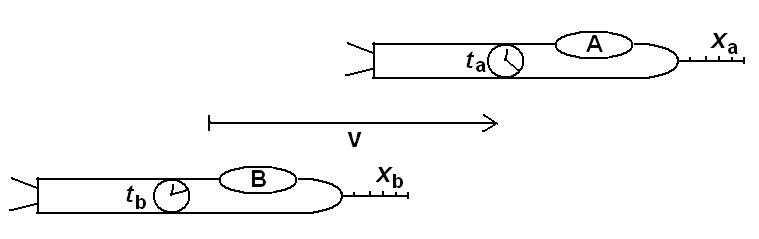
The twin paradox according to special relativity (click to view)
When separate frames of reference are considered in uniform rectilinear motion ('co-moving frames')
length and time intervals in one frame are related to those in another by a 'Lorentz transformation'.
This determines that the rate of clocks in co-moving frames are judged to be slow, compared to clocks at rest.
Also, the lengths of moving measuring rods are judged to be reduced along the line of relative motion.
If twin space travellers start from the same location, but travel at different velocities, both will judge their
twin to be getting relatively younger. If one twin switches to a frame that returns to the location of the other,
which will be the younger when they meet?
The answer is the one that changed frames, because his/her time and length coordinates are re-arranged
at the changeover.
This adds an offset determined by the Lorentz transformation to the elapsed time in any co-moving frame.
The twin paradox in Tri-space is explained in just the same way, but the Lorentz transformation
is nowhere and never used to mix length and time intervals directly together.
Time and empty space form a signed metric space, as do length and an empty time
dimension (x0). Space and time intervals in co-moving frames are linked by
the same Lorentz transformation, applied in both spaces together:-
with β = (1 - v2/c2)-1/2 and
δx0 is a measure of the time difference between simultaneous events judged
by co-moving observers. δxt is a (vector) measure of empty space.
The frame of twin B is described by x0b=0 and xtb=0. The frame of twin A is
related by interchanging the subscripts a <> b and changing the sign of v.
The transition of A to a frame non-moving relative to B is described by the net displacements:-
Δxa → ∑(δxa + δxta )
= β(Δxb - v Δtb )
cΔta → ∑c(δta + δx0a)
= β(cΔtb - v/c Δxb)
This is equivalent to the Lorentz transformation that mixes the space and time coordinates together, but it
does not happen until an observer changes frames.
Conclusions (click to view)
For only point observers making instantaneous observations, intervals of Real space
(δx2 - δx02) can be ignored compared to
δxt2. Then special relativity becomes equivalent to Tri-space,
so we can choose the single space-time metric for simplicity.
However, that is not justified if the observers are extended, like quantum states, or if the observations
take finite time. Tri-space is consistent with the Newtonian idea that length and time are different
fundamental dimensions, which cannot be mixed together directly.
This splitting of the space-time continuum into two, distinct, signed, metric spaces is called
'collective relativity', because it is significant only for composite objects.
It can describe time - irreversible equations within composite matter, like the diffusion equation. Eg:-
L(t) = f(x2) where L is a linear scalar operator such as δ/δt0:
also the Schrödinger equation (see Home page 2).
Robert Herrod
Örkelljunga, Sweden, March 2019
