Schrödinger's cat resolved
The paradox of Schrödinger's cat according to quantum mechanics (click to view)
In this famous thought experiment, a live cat is put into a closed box, together with a quantum trigger
that spills a phial of poison, so that the cat will die if a single particle decays.
The decay is certain to be detected and the detector is certain to liberate the poison inside the box.
The half-life for the decay is long, compared to the time required for the poison to kill the cat.
Thereafter, the system is described in quantum mechanics as a superposition of states in which
the cat is both alive and dead at the same time. The amplitude describing the dead cat increases with time
and the amplitude for the living cat decreases - they must follow the amplitudes
for the decayed and un-decayed particle.
Schrödinger's point is that the course of history can never actually be decided, within quantum mechanics.
The theory is essentially incomplete, as a description of changes in the structure of matter.
Interactions in Tri-space.
Two systems (a and b) are brought close enough to allow interactions.
Each is driven from Tempospace (T) and the connecting wave function is projected into
the corresponding Real space (r).
The equations of connection (shown on Home page 2) are depicted below.
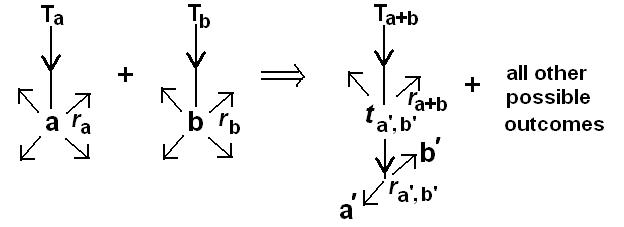
The Tempospace connections combine to drive the modified system with a scalar 'Tempodriver' (t)
in the Centre of Mass frame (see Fundamentals of physics).
All possible outcomes are driven (with the same total energy and momentum) in super-position.
This is equivalent to the quantum mechanical description.
Measurements in Tri-space.
When a third system is introduced (denoted O for Observer), which has different energies of interaction
with b and b', the system is resolved, selecting one definite outcome.
(It is not possible to drive states with different total energies in super-position.)
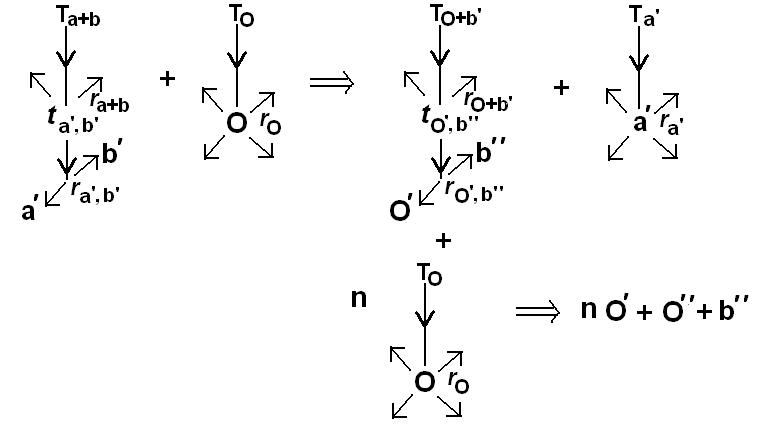
To make a classical observation, the detector may contain many copies n of O, which are
triggered by a single O', so that the change becomes macroscopic.
Other ways to collapse wave functions (click to view)
We can conclude that no system can enter an inelastic interaction whilst in a mixed state,
so the system is first resolved into a definite energy state of the coming interaction.
This seems to explain the greatest mystery of quantum mechanics, but what other circumstances
can cause evolving wave functions to collapse (into definite states) in the multi-metric theory?
Spontaneous disintegration can also lead to wave function collapse.
When a decay process emits a product which goes on to a secondary decay process, the possibility of
which is conditional on the first having occurred, then the first decay must be resolved.
This occurs because, for a system to decay, it's internal quantum numbers must first have definite values
(fragmentation is just another kind of inelastic process).
Also, the real space into which the secondary decay occurs must itself be driven,
and there can only be one projection of real space for each particle.
But note that resonant formation and decay processes do not collapse the wave function,
as the same tempodriver frequency and real space of projection apply throughout.
Conclusions (click to view)
No system can enter an inelastic interaction whilst in a mixed state; the system is
resolved into definite energy states of the interaction.
Given prior knowledge of a and b above, the detection of b' can determine some
properties of a', which becomes a separately-driven system.
In the case of Schrödinger's cat, the spilling of poison follows from the detection of an elementary decay
and (the death of) the cat is the detector of the poison. Both processes resolve the wave function and they
both involve large changes of entropy.
For these reasons, the cat can never be alive and dead, although it must take some time for the poison to act.
The requirements of wave function unitarity and the conservation of energy and momentum
are not enough to describe the course of history. That must be determined by the collapse
of the projected wave function, which is caused, in Tri-space, by changes in the driving frequency.
No system containig multiple connections to external Tempospace can be described by a single wave function
(unless they are identical).
The concept of tempodrivers does not exist in quantum mechanics - it is logically missing.
Robert Herrod
Örkelljunga, Sweden, June 2019
